Deep Knowledge Tracing (DKT)

J.Gong
2026-06-12
1.11min
Deep Knowledge Tracing (DKT)
Knowledge tracing is a quantitative method for teachers to know how much a student handles skills. Deep Knowledge Tracing (DKT) is to use RNN to solve this problem.
Simply explanation of usage of this technology, imagine a student was offered a series of questions of one kind of skill. Let’s say 5 questions. And you got results:
| 1 | 2 | 3 | 4 | 5 |
|---|---|---|---|---|
| O | X | O | O | X |
So, when he answers the 6th question, what would he answer?
Here is a simple implementation to show case DKT.
When the student answering the questions, the model will match the student with its trained data, and then calculate the possible correctness of one’s answer, even before answering.
The Implementation
First, get the data. Here I used random generated students’ data. Green means correct, grey means wrong.
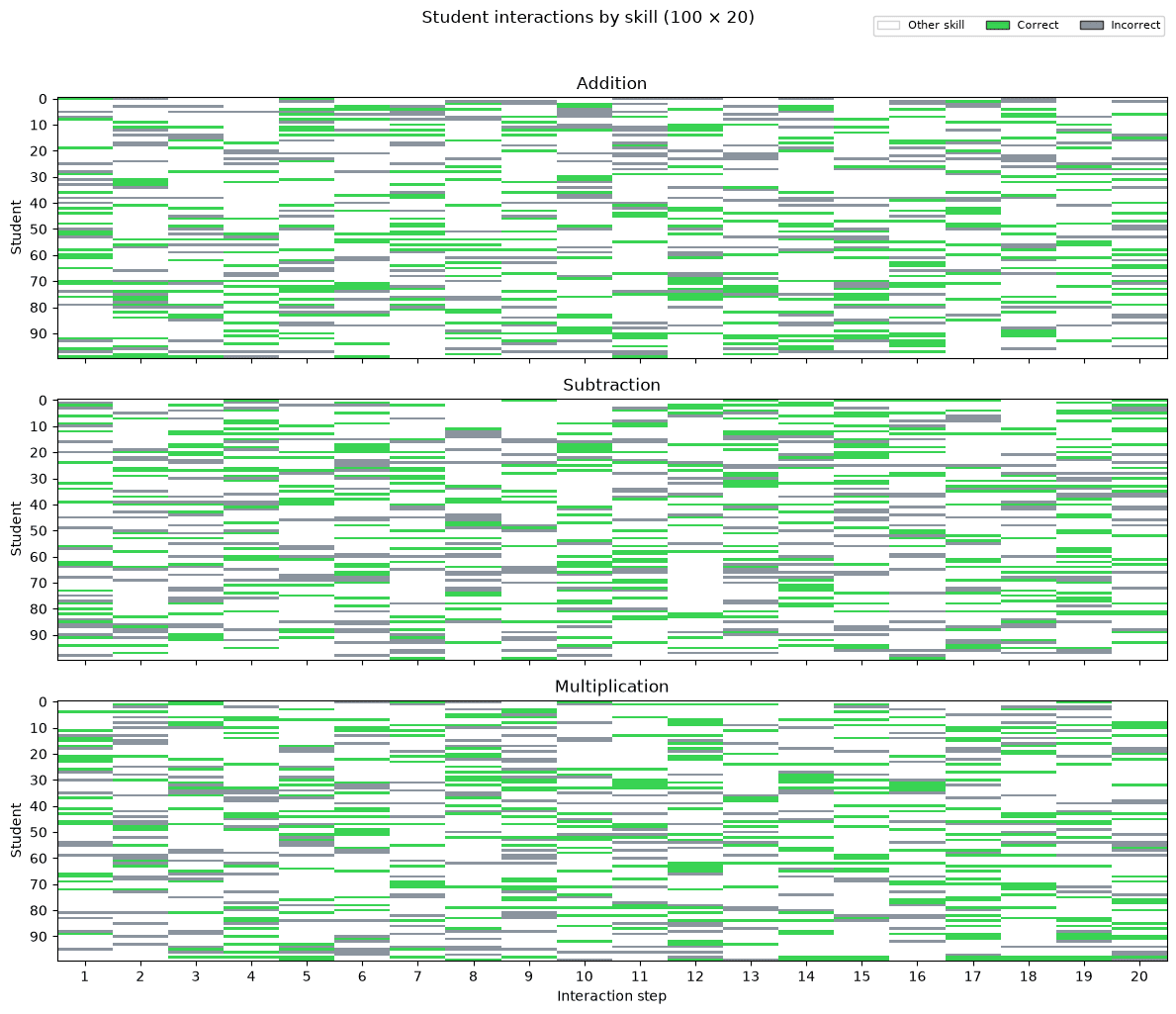
The algorithm uses LSTM(Long Short Term Memory) to build RNN. Use binary cross entropy for loss function.Trained in 30 epochs.
The model is exported through pytorch and save in ONNX format.
The advantages
The primary advantage of this model is its interpretability. Because predictions are entirely data-driven, you can trace outputs back to the original training data. This provides a clear pathway for model fine-tuning and avoids the hallucinations commonly associated with LLMs.
Note
The model uses randomly generated data rather than real-world datasets. Consequently, the model’s predictions are not accurate and are intended solely to demonstrate the technology within a browser environment.