Museum Suggestion using Deep Knowledge Tracing (DKT)

J.Gong
2026-06-13
1.08min
Museum Suggestion using Deep Knowledge Tracing (DKT)
Not only for exams, Deep Knowledge Tracing (DKT) can do much more out side of the education area.
It is not about the correctness of a question, but rather one’s preference for a product. For example, museums.
| A | B | C | D |
|---|---|---|---|
| like | not like | not like | like |
So before the visitor go to the museum E, would he like it or not?
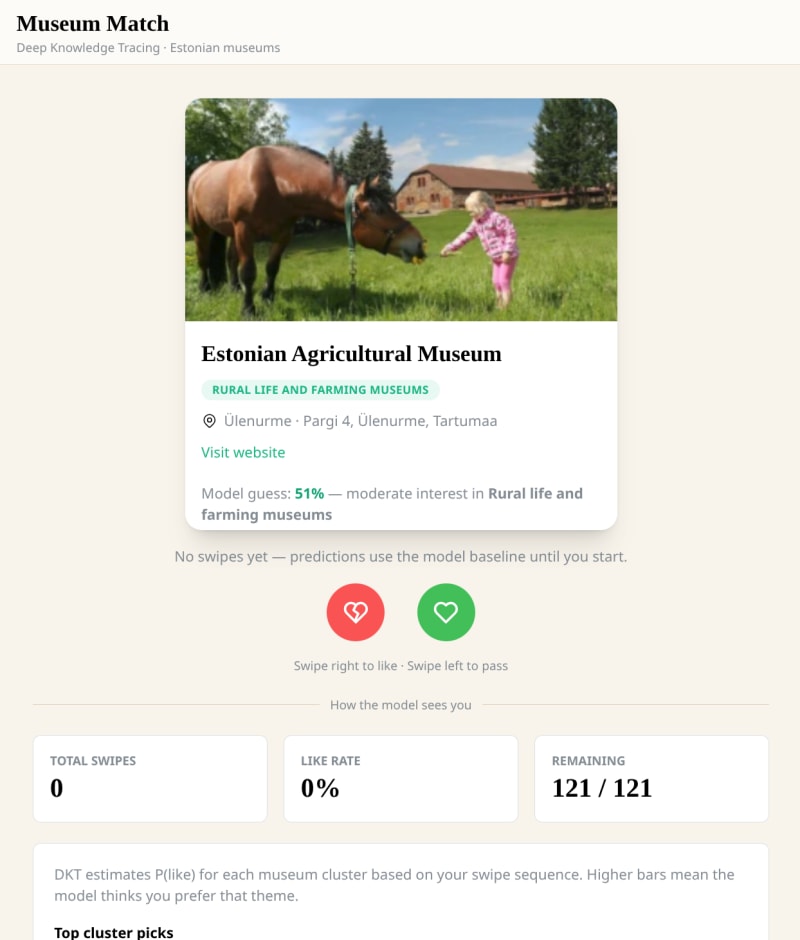
You can try this demo.
Implementation
The Estonian Museum Card website provides 120 museums’ description. I used Qwen3-Embedding-0.6B-GGUF to embedding them then use k-means to separate them into 11 clusters.
Then I use Google Gemma 4-e4b to label the clusters:
| cluster | cluster_name | museum_count |
|---|---|---|
| 0 | Pärnu art and nature | 5 |
| 1 | Coastal and regional museums | 10 |
| 2 | Tallinn cultural institutions | 25 |
| 3 | Tallinn city history museums | 15 |
| 4 | Transport history museums | 2 |
| 5 | Haapsalu history museums | 7 |
| 6 | Rural life and farming museums | 8 |
| 7 | Saaremaa museum | 1 |
| 8 | Virtual time travel experiences | 2 |
| 9 | Tartu cultural and academic sites | 16 |
| 10 | Rural and Local History Museums | 30 |
Then randomly generate the training data. In reality this should be done by real data.
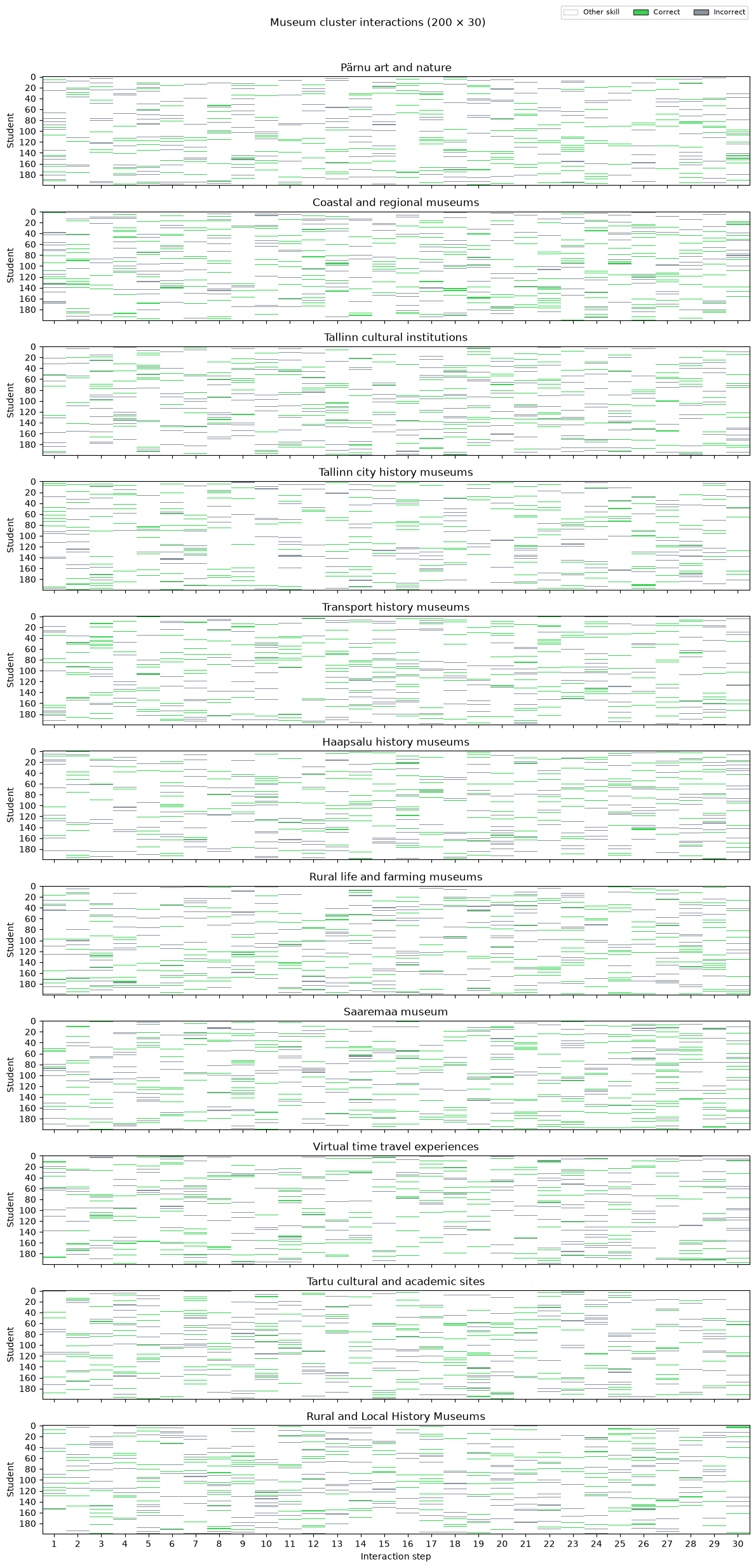
Then the other processes are the original DKT training process. Use LSTM to build the network. Use binary cross entropy to make the loss function.
Then you can check the result.
Note
The model uses randomly generated data rather than real-world datasets. The cluster is labeled with Google Gemma-4-e4b, so the labeling is questionable. Consequently, the model’s predictions are not accurate and are intended solely to demonstrate the technology within a browser environment.